Showing posts with label period pieces. Show all posts

Saturday, July 6, 2013

NEW: Lootera is beautiful but will definitely ask for your patience


Synopsis: Pakhi (Sonakshi Sinha) is the daughter of a zamindar, living a relatively quiet life writing in 1953 Bengal though she is ill. In waltzes archeologist Varun Srivastav (Ranveer Singh), with whom she inevitably falls in love. But Varun is not quite what he seems, and the love story quickly spirals into something else entirely.

“What does ‘lootera’ mean?”

That’s a question I heard several times.

My tongue-in-cheek answer? Two and a half hours of drawn-out, beautiful depression. (The real answer is that it roughly means a robber/looter, I believe. And that should tell you a lot about the film.)

Tuesday, June 4, 2013

The long hunt for Mughal-E-Azam, and finding a Mughal treasure


Shopping for Bollywood films is both science and art form. Rare is the film you can walk to Walmart or Target or other major store and buy on DVD (3 Idiots is perhaps the one exception). There are Indian groceries that carry a motley mix of pirated and legitimate, but mostly pirated. If you are very, very lucky, there is perhaps an Indian DVD store. But their selection is never expansive, nor guaranteed, and seeking a particular title is often an exercise in futility.

There are libraries, but their duties are first to books and then to DVDs and VHS. I have made some great finds at libraries, but there too it is useless to hunt for a specific title.

The new releases quickly show up streaming on Netflix and Einthusan, but the older titles are often hard to find online, especially if you require subtitles.

There are sites like Induna and ErosEntertainment.com to buy DVDs, and almost everything is on Amazon these days. But there is little to no thrill in that. It’s akin to those who complain about buying books on Amazon rather than in a bookstore, only worse. Not only can you not feel the DVD, it feels as though you haven’t given it the treatment necessary for such a rarity. You haven’t searched for the treasure. You’ve merely picked it up and methodically paid.
.
And so sometimes, the hunt for a particular title goes on, and on, and on, and on.

For this reason, I still haven’t seen Sholay. Or Mother India. Or Pakeezah. Or Anand. Or a half-dozen other things.
.
But for one classic, at least, my hunting has ended.

Friday, December 30, 2011

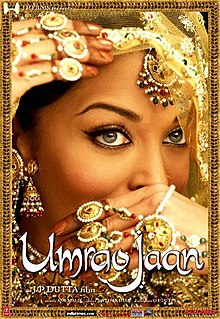
Umrao Jaan (1981 & 2006): A Courtesan's Tale...Times Two


Well, this was a Bollywood first for me: I've seen two versions of a film and am able to do a comparison. The 1981 and 2006 versions of Umrao Jaan! Forgive any spottiness in this post as I watched the 2006 remake in September and the 1981 version about three weeks ago with spotty subtitles.

If you don't already know… The films are based on a 1899 Urdu novel (often considered the first Urdu novel) called "Umrao Jan Ada" (امراؤ جان ادا) by Mirza Hadi Ruswa, and there is some dispute about whether an actual courtesan named Umrao Jaan existed (as Ruswa claimed). In the story, Amiran is from a modest family in Faizabad, and an enemy of her father captures her and sells her into prostitution at a Lucknow brothel in 1840. Renamed Umrao, she grows up to become a charming courtesan, and she steals the heart of Nawab Sultan, with whom she falls in love (earning her the "Jaan" in her name). But the match is obviously not an approved one and Sultan marries to please his family instead. After a sort of mishap with another would-be suitor who turns out to be a bandit, Umrao returns to Lucknow but finds it under attack by the British and flees. She attempts to return home but her family rejects her, so she goes back to the now-looted Lucknow brothel with only her poetry and courtesan's arts. Rekha plays Umrao in the original 1981 film, and Aishwarya Rai plays her in the 2006 film; Farooq Sheikh plays Sultan in 1981, and Abhishek Bachchan plays him in 2006. (Also interestingly but not necessarily importantly, Shabana Azmi plays the role of brothel owner Khannum Jaan in the 2006 film after her mother, Shaukat Azmi, played the same role in the 1981 version.)

Monday, June 20, 2011

Lagaan Redux: 7 Basic Reasons to Love Lagaan as a Film

Well, as promised, here I am again with another post about Lagaan. I promise this post will be much simpler and easier to read than the last one, in part because it’s a more basic look about the things to like about Lagaan and in part because my brain is kind of fried at the moment!

Some of the many good reasons that Lagaan is a great film that’s easy to enjoy:

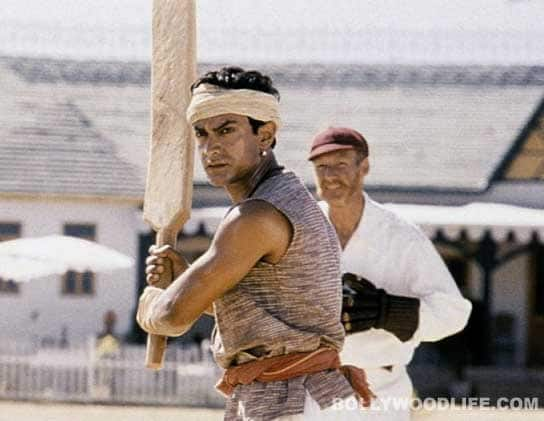
1.         Aamir Khan. Aamir is just an all-around likeable guy (which I'll probably end up talking about in my 3 Idiots post), and as Bhuvan that’s no different. He’s perfect for this role – fun, defiant, with the weight of the world on his shoulders, Aamir makes the audience connect with Bhuvan. Lagaan was my first non-SRK Hindi film, which was a feat since Shahrukh's charm was a part of the reason I fell for Bollywood, as amazing as that sounds. When I read Anupama Chopra's biography of Shahrukh, "King of Bollywood," I discovered that Shahrukh was actually originally supposed to play Bhuvan in Lagaan. As much as I love that man (a lot), I'm glad he wasn't in this film. I doubt Shahrukh's flair could have adequately filled the role of defiant but down-to-earth Bhuvan. Aamir is the man for this film.


2.         The love story. In a story so thoroughly pervaded by serious themes (see the epic essay post that preceded this), the love story of this film is so light and fun. Aamir plays a wonderful coy lover to poor exasperated Gauri, who was also so well-played by Gracy Singh that I had trouble believing this was her first film. Oh, and Lagaan contains what I still maintain to be the most romantic line I have ever heard in my entire life: "There's only one house in the village with a neem tree in the yard. There's also a big field beside it. There's some chickens, two cows, and three goats. And I know whose house that is! It's mine, you silly girl! One thing before you go. Mother likes you, too!" Yes, that makes absolutely NO sense out of context and it’s probably weird regardless of context, but it is so sweet!


3.         Everyone else in the film. I feel like every single actor in this film was perfectly cast and had a perfect performance. From Paul Blackthorne (who I always love as a villain; see White Collar!) as villain Andrew Russell to Rajesh Vivek as crazy Guran, everyone in this film was a character who held his or her own.


4.         The music. The music of the film is effectively flawless while also being broad and deep. It remains one of my favorite all-around soundtracks (the complete soundtrack of Hum Dil De Chuke Sanam is perhaps the only thing that comes close to rivaling it). A particular favorite is Radha Kaise Na Jale.

5.         The film is fair to the white characters. I know this probably sounds horrible, like the white person who has no right to complain, but it’s hard for me to watch films that blindly “strike back” at whites as a whole without considering that not everyone took or takes an equal part in colonialism or racism. (Speaking of HumDil De Chuke Sanam, that’s one that shows my point: All Italians are outrageously, inhumanly bad; Namastey London is another.) In this film, Elizabeth and the two white cricket umpires are not evil whites. In fact, they side quite frequently with the Indians over their “own” Englishmen, all because of a sense of fairness. That's basic humanity, not racism.


6.         Cricket, of course. Sports movies always know how to keep the action moving – and Lagaan’s cricket match manages to do that for nearly two hours, which is amazing! And as I briefly said in my other post about this film, Lagaan really takes the time to mostly walk you through cricket, so you can understand it even if you didn’t before. I credit Lagaan (and in part, Dil Bole Hadippa) for getting me attached to cricket. Me, a random American who doesn’t even keep up with baseball, the American equivalent. Now that’s something.

7.         The time period. I’ve said twice before that I am an avid fan of the period piece in more than just Hindi film. But in particular, the time period of this film allows for dynamic settings and brilliant costuming. It also, of course, takes a dive into one of the fascinatingly transitional periods of Indian history.

Annnnnd we’re going to end it there because I think my brain is now completely dead. I know there was more I wanted to say and had planned to say, but all mental function has now stopped.

But needless to say over the past few days of mulling quite frequently over Lagaan, I’m about to be on the hunt for it in the DVD shops!

Friday, June 17, 2011

Lagaan Week: Intellectually Engaging with Lagaan's Themes of Colonialism

So it's funny that I mentioned Lagaan a couple of times in the last post talking about Madrasapattinam because I'm now going to do a post about Lagaan itself! With several film reviews already in the works (notably 3 Idiots, Break Ke Baad and 36 China Town, which are all near finished) or backlogged and several films on the near queue, I take time out from all of them to join theBollywoodFan's LagaanWeek! Both because I love Lagaan and I'm eager to join in a theme.


Lagaan was my third Hindi film, watched at the recommendation of a friend from LiveJournal right after I declared my love for Bollywood based on Kabhi Khushi Kabhi Gham and Kuch Kuch Hota Hai. Please pardon the length of this post. Lagaan is a massive film (almost four hours) and it has a lot of relevance to my literary studies, so I have an inclination to talk of it like a work of literature within the realm of British colonialism-Indian nationalism and postcolonial discourse. I actually started off with the idea of a normal post, but as I got writing, much more talk of Lagaan's engagement in themes of nationalism, colonialism and reverse colonialism (anything that bends colonialism in favor of the colonized) came out than was healthy. SO. I ended up with this post, which is more like an English essay. (I posted about Lagaan again following this post because I want to engage with Lagaan on an intellectual level, but I feel like just doing that ignores some of the basic things I enjoyed about Lagaan as film, which, as Aamir himself says, is always entertainment at its heart.) Please also pardon any glaring mistakes in this post as I'm working on memory of a film that I haven't watched in six months.

As I mentioned in the Madrasapattinam post, I have a strong attachment to period pieces and an intellectual interest in colonial British India (and subsequently postcolonialism). Lagaan is, perhaps above all other things, a story of Indian nationalism in rejection of British colonial control. In order to save their village, which is being taxed to the point of starvation, a group of men band together to fight against the odds and play a game they don't understand against their English overlords. It isn't necessarily nationalism in the strictest sense because it is limited mostly to one village — with some other characters, like the Sikh Deva, joining from elsewhere — but I consider it a representative microcosm of nationalism at the very least, as Indians come together across class boundaries (including Untouchables) in the united defense of their land.

Lagaan was my first serious brush with cricket. I'd traveled to Australia in 2005 (at the ripe old age of 13) and watched a couple of matches but never understood them. Lagaan, by walking through the Indians learning cricket, taught me to understand the basics of cricket. After Lagaan and Dil Bole Hadippa, I was brave enough to test my knowledge of cricket by jumping on the World Cup bandwagon and riding it all the way to an Indian victory. I watched fervently through the World Cup and then through the IPL tournament. I have Lagaan to thank for finally explaining things to me and launching an attachment to a sport not even played in my corner of the world. So. If you want to understand cricket — and even more, if you want to understand some of the attachment of Indians to cricket — Lagaan is a good place to start. (This amazing profile of Sachin Tendulkar, the God of Cricket, by a cricket-dumb American sports journalist is also a good place to go.)

Talking about cricket is also a good place to start with Lagaan. Coming into the film with a knowledge of cricket isn't necessary (it helps, of course, but isn't necessary), but if you don't like cricket, you may want to beware. There is much more to the film than cricket — in fact, cricket is just the vehicle of the film's greater colonial themes, as I'll prove in a moment — but the entire second half of this extremely lengthy film is a cricket match. So, even with the excitements that keep cropping up, expect to watch nearly two hours of cricket.

Lagaan also points to the dichotomy of cricket with reference to colonialism: It is both a rejection of and a lingering attachment to the British Raj. It offers both the chance to beat the colonizer at his own game and the chance to join the colonizer's game, playing by his rules. This is what I personally consider one of the most fascinating lingering effects of colonialism on India: the fervent, fanatical, almost religious attachment that Indians have to a game given to them by colonialism. (And, for the record, this is not a phenomenon limited to India, though India is perhaps the most blatant example; all countries where cricket is now played are former British colonies, from Australia to South Africa to the West Indies.) Lagaan perhaps seeks to point out a reason for this fanatical attachment that seems to defy logic: It began as a way to best the colonial. The men become so familiar and obsessed with the game in their intense desire to beat the British. (Sidenote: The colonial impact on the world of sports is also an intellectual fascination of mine; if possible, I'd like to study it in graduate school.)

The film also contains several Indian characters who at first play along with the British colonials for various reasons, most of whom are not faulted for their association with the British. All, however, ultimately find that their allegiance is to their countrymen, and the expression of their shifted loyalties all come out within the heat of the cricket match. Cricket, then, serves as a heated nationalistic phenomenon that has not only united the would-be cricketers themselves but also their wavering fellow Indians (note also that tons of people from neighboring villages affected by the lagaan also arrive to cheer on the cricketers). Three such characters fill this "wavering Indian" role: Lakha, who spies on the Indian team for the British because of his personal hatred for Bhuvan; Ram Singh, who acts as an aide and translator until he is struck at the match by Russell; and the provincial Raja, who throughout occupies a precarious position that straddles the two worlds. The only British-serving Indian who defects outside of the match is Arjan, a stablehand for the British who joins the cricketers after Russell, angry after a rebuking session by his higher-ups, strikes him. The primary purpose of his defection, however, differs: Arjan is meant to join the cricket team after making disparaging comments about the likelihood of its success; he is not representative of a British-cooperative Indian who needs to realize his loyalties but of a skeptic who needs to believe in Bhuvan's cause.

If themes of colonialism pervade and consume even the sports match in Lagaan, the film's love story is also able to evade the trappings of reverse colonial discourse.

Instead, a sort of reverse colonialism occurs on a very personal level: Bhuvan, the Indian, has conquered the heart of Elizabeth, the Englishwoman, forever marking her (the end credits tell us she never marries). It's also a rejection of white femininity, which is traditionally held in literature as the most desirable of all femininity. The impacts of such a tradition still echo in Indian society: Fair skin is considered beautiful and preferable, especially among women although men experience it as well (Indian society still bears the marks of a divide one Indian man once explained to us as "white Indians" and "black Indians"). Even Aamir himself, of rather exceptionally fair skin, bears out this legacy. But within the framework of the film, lightness and whiteness are rejected as Bhuvan instead chooses the homegrown Indian girl, Gauri, who is also dark by comparison.

Admittedly, I know painfully little about Lord Krishna compared to other Hindu gods (thanks to Salman Rushdie and Midnight's Children I think I know more than I ever wanted to about Lord Shiva) and next to nothing about the Radha-Krishna-Gopi story other than what was (confusingly) explained in the film. However, based on the framework that the film provides, I don't see Elizabeth being Bhuvan's Radha. Whatever gratitude he seems to feel toward her, his white sympathizer, there is never any indication (beyond Gauri's unfounded jealousy) that Bhuvan loves her. Instead, I think the religious story is added perhaps as an attempt to distance the Bhuvan-Elizabeth relationship from its actual basis in racialized reverse-colonial politics. It is an attempt to make sense of a relationship that is about colonialism without using colonialism; in other words, it's trying to disguise the fact that it is about race and colonialism by using religion as an alternate framework.

Like the argument of Elizabeth as Bhuvan's Radha, the character of Elizabeth sometimes rings hollow as well. She seems to be frustratingly oblivious to actually understanding Bhuvan, whom she believes herself in love with. The story begins with her helping the Indians learn cricket out of the goodness of her heart and her desire to be fair, but it becomes her rooting for the Indians because she thinks she's fallen in love with Bhuvan. To top it all off, I bring up the same skepticism I brought up about Kites: How does she love Bhuvan when she doesn't speak his language? Sure, she learns Hindi — too fast, might I add — but she spends little time with Bhuvan apart from teaching the Indians cricket. There is little we're allowed to learn about her character other than the fact that she's willing to help the Indians because of a pursuit for fairness and a fascination from afar. As soon as we get this information, we're confronted with her silly, unfounded crush on Bhuvan. And for all of her "appreciation" of the Indians, she's also painfully blind. For the time that she does spend with the Indians, how can she not notice Gauri's jealous defense of Bhuvan? (Note the rapt attention with which she watches Gauri and Bhuvan sing to one another in Radha Kaisee Na Jale, at about 2:20.)

Perhaps the level of naivete is intentional — the good-hearted-to-a-fault trope, or the colonizer who is too nice (and naive) to understand the huge negative impact of colonialism. To a degree, I think that personification is apt; Elizabeth represents that not all Britons knowingly created the mess of colonialism, some were just part of it by accident. But for a woman who seems quite aware of the magnitude what she is doing and quite capable of scheming to get away from her brother, considering Elizabeth as merely naive when it comes to noting Gauri and Bhuvan's relationship perhaps seems too simplistic. Mostly, I view her ignorance as the fact that for the racialized reverse colonial politics to work, the white woman must ignorantly fall in love with the Indian man free of her own will (equivalent with her common sense), much the way as the Indian had no choice in British conquest.

Speaking of colonialism embodied in white characters, one cannot skip over the film's villain, Elizabeth's brother, Captain Andrew Russell. Again, I go back to the review I just posted about Madrasapattinam because I feel that the two films speak to one another in several ways. Madrasapattinam contains a very similar villain to Russell, a British officer in India who is meant to embody the evil of British colonialism and racism. But where Madrasapattinam erects a lifeless straw-man to knock down, Lagaan creates a real character facing pressure from overhead to collect more taxes and increase a grip on the peasants — a pressure he in turn takes out on those beneath him. Russell also has a real family in Elizabeth, a sister who runs off to teach his enemies how to beat him in the cricket match that his career rides on. None of this detracts from Russell's evilness as a villain (he is, after all, driven more by his career than attachment to his sister), nor subsequently from the evilness of the colonialism that he represents. It instead merely provides depth. Irony for Russell and his singleminded colonialism comes at the film's end, when he is shipped off to Central Africa. There, of course, Russell will continue to participate in colonialism, but among peoples even darker-skinned and more violent (two of a colonial's worst nightmares) than the Indians.

Now after saying all of this, I don't know what more there is I can say. I would love to address the conclusion of the film, but I don't know how much there is to say. India wins. Britain loses. The significance of that is understandable even without the depth of things I've spent this entire essay-post discussing and fleshing out. Perhaps the one thing left to say is that, in my view, the hero of Bhuvan represents a man with the courage that India wishes it would have had to drive the British out before 1947. That's part of the reason it's a historical film.

If you made it all the way through this post, cookies to you! Thoughtful comments on this labor of love intellect are also more than welcome.

Tuesday, June 14, 2011

Madrasapattinam (2010): Branching out to Kollywood!


So yesterday I finally FINALLY after two weeks of searching found a store in Manhattan that sells Bollywood DVDs. I swear I've searched every Indian store within 20 blocks looking for one, figuring around here it'd be like at home where the Indian bazaars sell mostly groceries but with saris, music and DVDs on the side. Apparently here Indian-Pakistani groceries sell... food. That's it.

But now that I've found my DVD store (Music of India at 28th and Lex), it's all good. I bought films I'd never heard of: 36 China Town, Chamatkar and Oh Darling! Yeh Hai India. I also bought Ajab Prem Ki Ghazab Kahani, which we've seen (Kiwi owns it). So! Those have been added to the collection.

But onward with more backlogged reviewing!


Madrasapattinam (2010): (Which it took me FOREVER to learn to spell AND pronounce)
 
Look, Kollywood! Time to break out of the Bollywood bubble. It’s our (well, really my; the others have yet to watch it) first South Indian and non-Hindi flick! And to be perfectly honest, Tamil sounds so funny to my ears. But does anyone have any recs for other good Tamil films? I'm interested to see the differences.

Synopsis: After the death of her husband, elderly and sickly Englishwoman Amy Wilkinson vows to return to Madras (now Chennai), where she spent her youth, much to the chagrin of her daughter and granddaughter Catherine, who accompanies her. She gives no reasons for it but embarks on a quest to find a man named Parithi who she knew some 60 years before. Through her memory, we learn the story of how young Amy (Amy Jackson), daughter of the British Madras governor, fell in love with Parithi (Arya), a man of the dhobi launderer class, but that they were forced apart when India’s independence forced Amy’s family to leave the country. In the present time, the elder Amy now seeks Parithi out to return the thali necklace (equivalent of a wedding ring) he gave to her before they were parted as a sign that no one could take her from India or from him.

I searched for this film high and low (as in really, you have no idea of the hours spent looking for it) after seeing someone talk about it on LiveJournal, only to find out after all of my blood, sweat and tears that it was… on YouTube. With subtitles. Well, there’s hours of my life I’ll never get back, but now I know better than to not check YouTube first.

First off, let me say I pretty much loved this film, which I almost knew I would. I love period pieces in any language, and I’ve often found myself wanting more period pieces set in colonial British India or newly independent India (maybe this is also just because I’m fascinated with British colonial literature, especially colonial India; I have a particularly unnatural attachment to Kipling). I don’t know that I’ve found many of them – Lagaan and Jodhaa Akbar (both of which I LOVED) and more modernly Devdas and Water. So this… definitely a happy find. (And any recommendations for period pieces would be much appreciated.)

Everything about the 1940s Madras setting was simply beautiful. Costumes (even though some of the formalwear was not 40s British appropriate), locations, politics…

I feel like singing, "One of these things is not like the other..."
The street in Madras.
And again. I wish I could have found you better images.
 The performances from the two leads, also wonderful. The attraction between Arya and Amy Jackson – both of whom are quite easy on the eyes – definitely sizzles from the beginning and continues even when the film feels like it could have done more to show their falling in love. I’m also quite impressed because Amy Jackson is, I found out, my age (20). Also I couldn’t tell for sure if she was dubbed by someone else (because I know that’s general practice for nonspeakers in Hindi film), but I thought she learned her own Tamil lines and she sounded great. However, the English dialogues of just about everybody in this film had awkward inflections to them that made them feel not quite right.

The love story itself was also quite powerful, emerging between the two least likely people to fall in love, and being such a huge impact on the lives of the two involved that Amy comes back to search for her Parithi 60 years later.

Good chemistry and neither of us is hard to look at.
And while I spent about 30 to 45 minutes lamenting that Amy, who was brave enough to sneak out and meet Parithi and also to defy her parents, turns into a bit of a wallflower while Parithi struggles with Robert (Amy's would-be suitor and the violent chief of police), her strength comes through in the end. She works up the courage and the smarts to escape her mother's attempt to drag her to Delhi, physically attacks Robert when she fears for Parithi and, ultimately, works up the emotional strength to push an injured Parithi into the river to save him and surrender herself when it looks like they'll be captured. 

Amy is the powerful protagonist of this film.

While Amy is gorgeous, she's not just another pretty face heroine. Both she and Parithi grapple with some pretty serious decisions about being together and sacrifice.

That being said, the film isn’t perfect. I had problems with its rhythm. In the early sections, the film has the most ridiculously sharp, low-budget-style transitions. I thought the film was excellent quality in the sets, filters and camera-work – all above and beyond what I was expecting. But the blatant lack of transitions (and/or lingering shots in some places) was distracting and cheapened things for me.

The villain, Amy’s would-be fiancé Robert Ellis (Alexx ONell), is also pretty paper-thin as far as a villain goes. He’s the stereotypical ruthless British colonizer/evil, possessive attempted-suitor. I suppose you could roughly compare him to Andrew Russell, the jealous Indian-hating officer villain in Lagaan, and Andrew comes out on top – equally as vicious with twice the character depth.

Obviously we don't like male Britishers in this film. To prove it...
...we have wrestling matches where we throw him over our shoulder.
And trust me, he gets his revenge with some very painful-to-watch torture scenes.
 The story doesn’t do much to explain what happens to Amy once she leaves Madras and goes back to England. We obviously know that she gets married and has a daughter. How did her marriage come about? Did she think of Parithi? What’s her daughter’s name? Does her daughter not know anything at all about her mother’s time in India? I kind of wanted these questions answered but got nothing.

An old Amy, whom we know precious little about, on her quest to find Parithi.

**Spoilers about the ending** And the ending… Really sad. The modern half of the story is very much reminiscent of the American film Letters to Juliet (perhaps it’s “inspired” by that) but with the much more dramatic ending. Basically it invalidates most of the struggle through the film, too, because Amy struggles for their love in the 40s only to be dragged away in 1947 after independence and then goes through everything in the modern period searching for Parithi as her health fails her only to find out he died 12 years before. (And on top of that, we don’t really know how he dies.) The only way that Amy and Parithi get to be together is when she DIES on his grave. Kind of a downer. The whole film kind of made me hope that for all that they went through, Parithi and Amy would at least be reunited briefly in old age. Not so. 

Oh, hai. We're both dead so now we can be together in fantasy.

**end spoilers**

Overall, definitely one I’d recommend watching, and I’m looking forward to seeing more films with either Amy Jackson or Arya. :)