Shopping for Bollywood films is both science and art form. Rare is
the film you can walk to Walmart or Target or other major store and buy on DVD
(3 Idiots is perhaps the one exception). There are Indian groceries that carry
a motley mix of pirated and legitimate, but mostly pirated. If you are very,
very lucky, there is perhaps an Indian DVD store. But their selection is never
expansive, nor guaranteed, and seeking a particular title is often an exercise in
futility.
There are libraries, but their duties are first to books and then
to DVDs and VHS. I have made some great finds at libraries, but there too it is
useless to hunt for a specific title.
The new releases quickly show up streaming on Netflix and
Einthusan, but the older titles are often hard to find online, especially if
you require subtitles.
There are sites like Induna and ErosEntertainment.com to buy DVDs,
and almost everything is on Amazon these days. But there is little to no thrill
in that. It’s akin to those who complain about buying books on Amazon rather
than in a bookstore, only worse. Not only can you not feel the DVD, it feels as
though you haven’t given it the treatment necessary for such a rarity. You
haven’t searched for the treasure. You’ve merely picked it up and methodically
paid.
.
And so sometimes, the hunt for a particular title goes on, and on,
and on, and on.
For this reason, I still haven’t seen Sholay. Or Mother
India. Or Pakeezah. Or Anand. Or a half-dozen other things.
.
But for one classic, at least, my hunting has ended.
What
is it about DDLJ that is so captivating? Certainly it’s a great film, but other
great films have come and gone in the 17 years that DDLJ has been running,
cementing the title of longest-running Indian film in history. Other love
stories have come and gone, but DDLJ remains. Other blockbusters have come and
gone, and DDLJ remains.
It’s
true that DDLJ perhaps gave birth to a new generation of Bollywood film — a
film by the next generation of Chopra, with tenets of the classic Yash Chopra
style — but so, in ways, did the youth and boldness ofRangeela (in the same year), Amitabh Bachchan’s
angry young man films of the 1970s, Bobby in 1973 as a story of young love, countless other films. Yet they haven’t had the theater run that DDLJ has.
Some
have said to understand DDLJ’s power, one has to understand the India of 1995,
the power of globalization and the way that Raj’s international style and desi
heart spoke to a generation and a growing diaspora. The way that DDLJ became,
as Vijay Mishra says in his book Bollywood Cinema, the first film to directly
address the NRI population — the thousands who are far from India yet still
Indian at heart.
And
though those factors are certainly a part of understanding DDLJ, I think
looking at just that misses the fact that DDLJ is fundamentally appealing in
many ways. The first time I watched DDLJ, I had barely stepped into the Bollywood
world, and all of the globalization/diaspora mumbo jumbo wasn’t even on my
radar. But I loved DDLJ.
DDLJ,
I think, appeals to the romantic in all of us. It has the Swiss Alps backdrop,
an obstacle in the heroine’s disapproving family, boy-girl antagonism that
becomes love, dramatic train scenes — pretty classic characteristics of the
Bollywood romance. Add on top of that a bewitchingly wonderful soundtrack of
catchy and beautiful romantic tunes, some of 90s filmi music at its best. And
the checklist of Bollywood blockbuster must-haves is not only complete: It’s
filled out in style.
There
is something to be said, too, for the remarkable chemistry of SRK and Kajol
(not to mention the knockout supporting cast). Perhaps I’m slightly biased on
this point because SRK and Kajol are two of my favorite actors, but there’s a
certain sizzle there that you really can’t deny. DDLJ launched the lover boy
persona that SRK has mastered and been unable to fully escape for nearly two
decades. I’m always talking about how SRK has a charm that’s undefinable and
powerful, but I think the particular appeal of Raj as a character has to do
with more than SRK.
Most
centrally, DDLJ features a young man who is a troublemaker — he fails his
exams, parties constantly, is never serious, puts the moves on any girl in his
path and steals beer from gas stations. But once he falls in love with a girl,
we discover that he is, beneath the whole bad boy act, honor-bound and
big-hearted — dilwale. He wants to marry Simran — though he's never loved a girl before — and not just that, but win her the right way because he is so upstanding. Isn’t that most women’s romantic fantasy about bad boys?
That beneath it all, they’re good at heart?
And
Simran may cower in fear of her father, but that doesn’t mean she’s weak. She’s
stubborn and forceful with Raj from the moment they meet. A firecracker hidden
in a somewhat demure package. A woman who respects her family and tradition but
also has a spark and a temper — isn’t that what many men wish for?
Let’s
not forget the way that the love unfolds: unexpectedly, right in the face of
Simran’s impending marriage. Simran had, as she tells her mother, resolved to
be happy for one month and consigned herself thereafter to an unhappy life in a
foreign country with a man she’d never met. And then Raj sweeps into her life.
And Raj is a freewheeling lover who treats Simran like he would any other girl
— i.e. flirting incessantly but never seriously — before Simran’s nature and
good heart unexpectedly draw him in deeper. (“I’ve had many affairs,” he tells
her, “but I’ve never been in love.”)
And
then the lovers embark on a quest to win over Simran’s family — effectively
winning over an audience in the process — while also meeting behind closed
doors as, well, two people in love. (And while wooing Simran’s family, Raj — in
true SRK fashion — is particularly adept at wooing the women, of course.) It’s
both a public and private love affair, with all of the thrill of a clandestine
love affair and all of the jokes and smiles involved in gaining acceptance and
approval from a family. A love so honorable it refuses to elope but not so honorable that it won't lie to win approval.
Long
story short, DDLJ is probably the perfect film love story.
And
let it never be said that the Chopras don’t have a mastery of the small
romantic gestures as well as the large that will make your heart melt. From Raj
convincing Simran they’ve slept together only to tell her he’s certainly joking
because he respects her honor to trying to sneak a kiss behind a pillar — only
to have Babuji interrupt — to confessing love in a field of yellow flowers
after Raj has flown halfway around the world for Simran. Whole lists are
dedicated to the top romantic moments in DDLJ.
DDLJ
is fundamentally a story of loving, desi hearts found in unlikely places. A
big, honest heart with desi values is found in freewheeling, partying spoiled
London boy Raj. Simran finds the balance in her heart to love Raj and still
respect and honor her family. Simran’s Babuji leaves London and seeks comfort
in Punjab because he believes Londoners are all heartless and unfamiliar and
that many second-generation desis like Raj “dishonor the name of Hindustan.”
When he meets Raj’s Pops in Punjab, he says his London clothes belie his desi
persona, to which Pops responds, “Clothes? I keep Hindustan in my heart.”
That’s the sentiment that speaks to the diaspora, what I was talking about
before.
But
more, I think, than finding desi values, DDLJ is about finding good people and
goodness in the hearts of everyone. Because there’s Raj and Simran’s initial
antagonism that turns to love (well, maybe the antagonism is only Simran’s)
because both unexpectedly find good hearts in the other. And then despite the
antagonism between Simran’s father and Raj, Raj is able to ask for forgiveness
and ultimately (in the last, y’know, minute of the film) Simran’s father is
able to forgive his grievances with Raj and let Simran go to him because he
recognizes that “no one can love you as he does.”
That
is why I say DDLJ appeals to the romantic, the optimist, in all of us and not
just the desi diaspora.
It’s
one of the several powerful factors that contributes to make DDLJ an enduring
masterpiece that other films will continue to chase.
This post! I've been wanting to do it ever since we started this blog, but I just got inspiration again finally and decided to sit down and knock it all out.
11 Reasons Why Dostana > Hollywood's Version
So, we all know it happens. Bollywood quite frequently and quite shamelessly rips off Hollywood films. Sometimes it's bad, sometimes it's brilliant. Right now, I want to talk about one that is BRILLIANT in all caps.
Dostana (2008), about two men who pretend to be gay to live in a nice apartment and get their immigration papers approved quicker, is a shameless copy of the Adam Sandler-Kevin James flick "I Now Pronounce You Chuck and Larry" (2007) about two firefighters who pretend to be gay to keep one's pension benefits.
I watched Dostana first several months ago with trepidation because I really didn't find Chuck & Larry to be that great of a movie. In fact, I found it pretty much downright unfunny. Personally I'm not the biggest fan of Adam Sandler, but the man definitely has his moments; I find Kevin James definitely funnier though he's also not a favorite.
Well let's just say I was more than pleasantly surprised when I watched Dostana. I was in fits of laughter the entire time, and this instantly catapulted itself into my favorites list. I then made sure that Kiwi and Papaya watched it. Papaya never saw Chuck & Larry, but Kiwi agrees that Dostana is a thousand times better. We now bring you some reasons why, then some rambling/expounding below.
1. Abhishek Bachchan is funnier than (professional comedians!) Adam Sandler and Kevin James combined.
2. John Abraham is a million times better-looking than Adam Sandler and Kevin James. And that may be an understatement.
3. Friendship is a more translatable message than the garbled gay-rights-maybe-law-maybe-sacrifice? message of Chuck & Larry.
4. Abhishek and John pull off being a gay couple better than Adam Sandler and Kevin James, even with the horribly fake kiss. I mean, really, this movie gave us AbhiJohn! And what did Chuck & Larry give us? ...more Adam Sandler and Kevin James.
5. Music like Desi Girl! (Which is my ringtone. Irony being that I am not a desi girl except at heart.)
6. Kirron Kher (aka Dimples! as we call her) coming in as Sameer's mother presents the horribly hilarious complication of family entanglements that fails with Larry's kids, who are barely around.
7. Chuck & Larry tries to make a comedy from a serious situation (James's character is losing pension benefits as a widower); Dostana is a comedy with a heartfelt basis.
8. Dostana is young and fun, and Chuck & Larry is... not. Kevin James and Adam Sandler are, well, old. And yes, old people are funny too, even James and Sandler (see: Grown-Ups, Paul Blart: Mall Cop), but the youth of Dostana is a definite appeal.
9. Miami > New York for comedy and sex appeal. Florida girls may be biased, but come on, you have to admit you go to South Beach for fun in the sun, not New York.
10. Jessica Biel's character may have more substance and brains than Priyanka Chopra's, but the love story in Dostana (with Bobby Deol) makes infinitely more sense.
11. Bollywood avoids sex, but even the bed scene was better!
I love Abhishek Bachchan for many reasons. The poor guy is one giant gangly, goofy teenager, though (you probably would be too if you were a 6'3" [195 cm] monstrosity in a country where the average man is 5'5" [165 cm]), and it sometimes makes his "serious" dances in other films... Well, laughable. I'm sorry, but the man is ALL LEGS and no rhythm. Here he just gets to be that wildly hilarious gangly awkward teenager and it's GREAT (again, see Desi Girl). As a matter of fact, I wish Abhi would quit trying to do too many serious roles (taking on drugs and stuff in Dum Maaro Dum) and just have fun more often (or mix them, like in Bunty Aur Babli).
John Abraham is another one that I feel often gets lost in more serious roles. The man is adorable. Like I love it when he makes his goofy-looking laugh face. Let him be adorable. And he's darn hot too. As petty as it sounds, I'm tired of him being in roles where he has horrible long hair and you can't enjoy the beauty that is John Abraham.
And even though the first time I watched it, I thought Abhimanyu (Bobby Deol) was the peepeeman, I have to admit, I became increasingly endeared to Bobby as I watched the film over and over again. And, wonder of all wonders, he doesn't have horrible hair in this one!
But anyway, back to the comparison this post is really about. Really, I think the main problem with Chuck & Larry is that the movie started with an issue and tried to spawn a comedy off of that issue, so it tries to straddle the line between serious ideology-thumping and comic situations and juxtapositions. The two don't really mix. On the other hand, Dostana starts off with a comic situation that gets even worse (when both Sameer and Kunal decide they've fallen in love with Neha), but the whole thing is interwoven (not straddled) with a story of friendship and acceptance (which go hand-in-hand).
Yes, perhaps Chuck & Larry has a more serious and/or tightly written plot, but I'd go to bat with you over the quality of its weaver work. Does Chuck & Larry weave in four love stories (Abhi-Neha, Kunal-Neha, Sameer-Neha, Sameer-Kunal), a kid and a begrudging mom? Nope!
And I will say that on the surface, Jessica Biel's character in Chuck & Larry gets a lot more brains and substance to her (she is a lawyer) than Priyanka Chopra's Neha, who has spunk but ends up mostly being just batted between the three guys that love her. BUT Jessica Biel has to walk around in a bra and underwear and put Adam Sandler's hands on her boobs for sex appeal. All Priyanka has to do is stand up in a shimmering gold one-piece bathing suit.
All the appeal with twice the clothes and none of the sluttiness. Doesn't that = more power?
In case you haven't gotten it yet, I think Dostana puts Chuck & Larry to shame, especially in the laughs department. This film never ceases to make me laugh, no matter how many times I watch it.
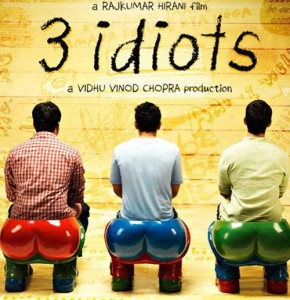
In keeping with the line of "highly anticipated films" that we seem to be on a streak of (with Aisha, Kites and Madrasapattinam) and a line of Aamir Khan, we now bring you a post on 3 Idiots. We'd heard so many good things about this film, and images from Zoobi Doobi were splashed across a copy of The Plot magazine (BIG Cinemas' magazine) that Papaya has from early 2010. We were shocked and dismayed when this highest-grossing Hindi film of all time (unadjusted AND adjusted) was nowhere to be found for months on end — not on Netflix, not in any regular store, not in the first bazaar we went to in the end of March. Luckily, we found it at the second bazaar we went to in April (the one in my college town). And then in May, after we'd bought it from the bazaar, it became available in the local Target and Walmart. Last month it also became available at home on our cable's pay-per-view. Go figure.
So let's just say that 3 Idiots is a big hit, and we all three understand why. After watching it multiple times and raving about it, Papaya and I shared the film with our 14-year-old brother and Kiwi shared it with her fiance. Neither watches Hindi films, but both thoroughly enjoyed 3 Idiots.
I don't know that I can sing the praises of this film enough, but I'm going to take a heck of a crack at it because IT IS A MILLION KINDS OF WONDERFUL.
I will now sing the praises of this film in chorus with these fellows!
The film, which I found out afterward is quite similar to Dil Chahta Hai in premise, has an across-the-board appeal: There's youth, age, humor, romance, friendship, art and a moving statement. It has a dose of just about everything a person could look for in a film. There are tests being failed, weddings being crashed (twice!), manhunts going on, lots of big dream-chasing, people being electrocuted, and so, so much more.
I think a good deal of the power of this movie is indeed attributable to Aamir Khan. I love all three Khans in their own right, and I feel like Aamir is often the underappreciated or at least dark horse Khan because he doesn't have Salman's attitude orShahrukh's charm and flair. But whatever Aamir may lack in overwhelming star power, I've always found him to have this buddy-buddy have-a-good-time quality that gives him a level of chemistry with everyone he works with. I have seriously never seen an Aamir film where he didn't have chemistry with his co-stars — male and female alike.
This film is no exception — the three-way bromance between Aamir, Madhavan and Sharman Joshi is fun and heartfelt (there are many manly tears!) and committed — Raju jumps from a third-story window rather than choose between sacrificing Rancho to the principal or disappointing his family by being expelled.
I want to be in her place right here, with that dress and everything.
The chemistry between Aamir and Kareena Kapoor is also electric. While Bebo does have a tendency to get on my nerves (she has since my Hindi-film experience began with Kabhi Khushi Kabhie Gham), she and Aamir were a perfect blend of zany and brilliant together and I never felt annoyed with her once. (Even though the thought of Bebo as a doctor quite frightens me. I'm glad Pia was always a medical student, never shown as an actual doctor.)
Aamir also has a zany adorableness that shines and shines and shines in this film (which I think is part of the reason that the jodi with Kareena works) and is one of the reasons why I increasingly love Aamir. Shahrukh has a quick tongue-in-cheek humor, Salman does strange things with a straight face (like peeing on a haystack in Ready), but Aamir is just downright goofy. AND IT IS ADORABLE. And on top of that, the man is pretty much pint-sized by my standards (I'm actually taller than all three Khans, but Aamir is particularly tiny), which I find all the more adorable! Yes, Aamir is by far the most adorable of the Khans. (And Sharman Joshi also has a level of this zany adorableness, though he's not on par with Aamir.)
SO ADORABLE WORDS CANNOT DESCRIBE IT!
I also love the soundtrack to this film. It's catchy, snazzy, fun, mellow and sweet in all of the appropriate levels. Kiwi, Papaya and I walk around singing and whistling "Aal Izz Well!" all the time.
The film also takes on real issues — the validity of the education system and student suicides — and grapples with them in powerful ways without allowing them to beat you over the head or be way out in left field like a lot of films (I'm looking at you here, Deepa Mehta). The film definitely has a darker side when dealing with gruesome suicide: One student, ironically named Joy, hangs himself from a ceiling fan, and Raju jumps from a three-story window to strike pavement below — pretty gruesome stuff. But it is a story about college and youth, and even the darker side of that can't drag this story down too far. The painful, weighty topic of suicide is balanced out by pee jokes and it WORKS.
In fact, I think this is a brilliant college film — possibly the most brilliant college film I’ve ever seen — because it captures just about every faucet of college: friendships, enemies, tests, the greater struggle of learning, growing up, facing parents, having fun, watching classmates fail, depression, pressure... And one thing that's utterly amazing to me is how well Aamir, at 46 years old, plays a college student so freaking perfectly. I think he'd play a better college student than me and I am one.
Such a perfect little crazy brilliant genius.
The questions that 3 Idiots poses about the value of education are also really thought-provoking. You have the character of "Rancho" who *spoiler alert* isn't actually Ranchoddas Shamladas Chanchad (what a name!) but goes through all of college under that name to get the degree for another man — and all Rancho gets out of it is the benefit of learning. Now, I really love learning. I really do. But there are times in college where the only thing that keeps me going is the knowledge that I'll soon have degrees to show for it (T-minus six months!). This film presents the question of how much do we really learn for learning's sake? How do we really experience learning when we're so focused on that piece of paper at the end? And also a slight related nitpick after this, since Rancho goes off and becomes a scientist after he falls off the radar... How does he do that without a degree? How does one secure research funding without a degree and credentials? Forgive me, I'm just a little skeptical.
The only other thing that bothers me really in this film is the scene where the baby is delivered. I'm usually not a big fan of babies-being-delivered scenes in films period, although I will admit that I saw great purpose in this scene. It shows that Rancho thinks on his feet and applies his engineering knowledge to real life (not that you didn't know that from the first scene where he electrocutes a guy with a spoon) and it repairs the divide between Virus and Rancho. Buttttttt for a film this well-made, you'd think they could have done better than one of the fakest looking babies I've ever seen in a film!
It was inevitable that even Virus would love Rancho at the end. He's that loveable.
Annnnd now that I went through this whole post, I really want to watch this film again! Unfortunately, I am in New York and my DVD is in Florida. -__-