Showing posts with label literature. Show all posts

Friday, November 22, 2013

NEW: (Goliyon Ki Raasleela) Ram-Leela: Every bit the beautiful tragedy you expect

Synopsis: In Ranjaar, a gun-laden “town like no other” in Gujarat, the Rajadis and the Saneras are feuding like it’s 1500 and they’re the Capulets and Montagues. Except, you know, with more guns and cellphones. But amidst the feud, there is Ram (Ranveer Singh) the Rajadi and Leela (Deepika Padukone) the Sanera — who must, of course, fall in love and work to end the feud even as it threatens to swallow them.


Let me just start my review by saying much of this movie is completely and totally Sanjay Leela Bhansali. As one might expect considering the man himself wrote, directed, produced and composed for this one. The film is gorgeous (evidenced by this image-heavy post), apparently painstakingly crafted frame by frame — and then SLB takes that pain out on the viewer in the storyline. He’s one who really knows how to make it hurt, most of all by letting you hope at certain moments. More on that later.

But just as you might expect, the music resonates (dammit if dhols aren’t ringing in my head all over again), the cast members are pushed to excellent performances, the symbolism is very prominent and even the most common of things are laden in detail and opulence. And also true to Bhansali form, despite all of the many, many things that happen, the film has its dragging moments.


Saturday, March 23, 2013

In defense of masala and “mindless” cinema

“Sometimes with Indian films, you have to take out your brain, park it at the door, watch the film and collect your brain on the way out.”

That’s how a friend — an Indian friend — recently described typical masala. It is, in a way, right. (Of course, I’d argue that it doesn’t only apply to Hindi cinema and the stereotypical Bollywood masala; it applies to many “mass-entertainment” films in any language.)

But I have recently experienced a great deal of backlash among desis, especially those in the U.S., who consider such cheap entertainment like popular masala as worthless and even despicable, a black mark on Hindi cinema.

When I mention that I’m more than okay with the singing and dancing and wild, logic-defying antics (all hail the supernatural powers of Salman Khan’s muscles!), there are inevitably frowns from these high-brow consumers of cinema.

But why, I ask, must films always be serious to have merit?

What is the problem with cinema that is, in fact, cinema? Not overly serious, instead accepting of the fact that cinema is not real life?

Isn’t that what fiction is meant for? It is, after all, not reality. There is a reason we turn to fiction as escapism. Books, movies, television — the medium makes little difference. We all want to escape to another place, time, story. We all do it in different ways.

I know it would behoove the nose-in-the-air serious-cinema elite to admit that, but that makes it no less true. They would prefer to believe that they never try to escape reality through fiction, but I contend that everyone does in some form or another, whether they admit it to themselves or not.

Why is using literature as a means of escape more acceptable, more high-brow, than using cinema as a means of escape?

To a degree, the sentiment has its roots in film history. Commercial film began as entertainment for the masses, with motion pictures at fairs and nickelodeons. Early commercial film also evolved out of vaudeville traditions, and vaudeville got its name from voix de ville, literally “voice of the city.”

Literature, on the other hand, has always been the game of the upper crust since it requires literacy and often a knowledge of prior classics. The novel was a distinctly middle class phenomenon, but even then, it was often aimed more at an upper-middle class than what we would consider “the masses.”

Oh, yes, have I mentioned that this defender of mindless cinema has a degree in English literature with forays into early film studies? Indeed, I am a schooled and trained critical thinker. I have been taught theory upon theory, formalism, postmodernism, structuralism. I can throw around “mise-en-scène” and other fancy terms.

So, yes, I can apply theory, criticism and intellect to what I watch. (You might notice that in some of my reviews here on certain films and the themes of postcolonialism.) I can enjoy a good mental workout through film.

But I am also a journalist. I deal with the horrible dark side of reality every day. Poverty. Crime. Death. Destruction. I love journalism, but it is definitely a morbid business, inescapably depressing in large doses.

So I don’t go into a theater to relive the things I face every day in reality. I go in to enjoy watching a piece of fiction and yes, even to stop thinking about reality for a while. It’s not a leap to say that I am using fictional film as a means of escape, and it’s entirely possible that you will look down on me for doing it.
But then my question is — why not? Why shouldn’t I enjoy cinema that is not reality? Why must art imitate life to be of value?

Why must I always use my brain to enjoy something? Must everything I consume be in the interest of bettering myself? (I will point out to you that if you answer “yes,” you should never eat dessert again.)

Why can’t a person just enjoy something without stopping to think about all things serious and weighty? Why is a good laugh something to be discarded as cheap rather than embraced as a piece of simple enjoyment?

It is true that I love to laugh maybe a little more than most. It has a lot to do with growing up in a house with a father who could be Jim Carrey and George Lopez’s comedy lovechild and in an extended family where reunion shirts with the slogan “It may be crude, but we’re O’Conners” were proposed. This somewhat out-there sense of humor means I love desi comedies in which nothing is too ridiculous as long as it gets someone to laugh.

And, really, the ridiculous antics of masala are very much the same: nothing is too ridiculous as long as it brings someone joy. The antics are both meant to make you smile — shaking your head, thinking, “Only in the movies” — and also to laugh. Dismissing them with a sneer or an upturned nose as grotesquely ridiculous is so closed-minded to something that occupies a quizzically odd place where the appropriate reaction is somewhere between “laughing at” and “laughing with.”

And, really, their goal is to bring you joy.

What is so wrong with that?

Wednesday, February 29, 2012

Just a hello — and a piece of historical fiction I'm working on

Hello, all! Sorry there's not much exciting going on over here. The only Bollywood I've watched since Ek Main Aur Ekk Tu was re-watching Wake Up Sid (with my cousin, who enjoyed it!) and Dil Bole Hadippa. I really need to watch something soon... I had a dream about Bollywood last night (starring Rani Mukherjee and Big B) that seemed to be telling me I need to watch something.


I also recently read Devdas, so I may post about that in the near future.


In other news, I suppose I haven't been blogging as much lately because I've been working on writing again. If you didn't already know, yours truly is both a (working) journalist and a (aspiring) novelist. I'm currently working on a piece of historical fiction about Anglo-Indians (Britons in India) in 1900 colonial Bombay. I describe it as: "In 1900, Adelaide Marshall has a mission: travel to India and drag home her brother James, who has lived there for five years and become engaged to an Indian woman despite family disapproval. But there, Adelaide is forced to confront that India is both foreign and fascinating, its people confusing and captivating, and that breaking her brother’s engagement is not as simple as she expects."


If you would like to read the story (it's about 18,000 words or 25 document pages and counting), you can find the story HERE. Any feedback, here or on the document itself (see the comments function), would be greatly appreciated!

Monday, January 30, 2012

Dabbling in the murder-suicide side: Omkara and Tere Naam


OK, so I am being a terrible Bollywood blogger. I keep talking about these movies I’ve seen and how I want to write up posts about them and I take forever to do it if I even remember (although I am admittedly better about this kind of stuff than my nonexistant co-bloggers!). Here are a couple more of the films I saw from the library about a month and a half ago.

The reason I lumped these two films together rather than mash them in with the post about Pyaasa, Bombay and Bobby is that both Tere Naam and Omkara are darker films, each in a different way.


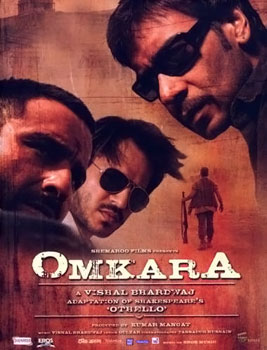
Omkara

Omkara is a retelling of Shakespeare’s “Othello,” desi style. Now, as someone with an English literature degree, I know a thing or two about Shakespeare — I even took a semesterlong course in nothing but Shakespeare — and about how his storylines underpin just about everything (including, for example, The Lion King as “Hamlet” for kids). But I am admittedly a bad English major who does not love the man, and Othello is one of those rare texts about which I know little except the (tragic) ending.

However, it’s probably a good thing I didn’t know much about Othello going in. Much of the story — and therefore much of Omkara’s story — is dependent on back-stabbing and power politics within a ruffian army (in Omkara’s case, it’s more or less a gang of thugs).

Friday, December 30, 2011

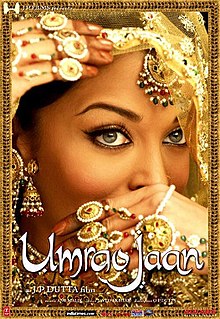
Umrao Jaan (1981 & 2006): A Courtesan's Tale...Times Two


Well, this was a Bollywood first for me: I've seen two versions of a film and am able to do a comparison. The 1981 and 2006 versions of Umrao Jaan! Forgive any spottiness in this post as I watched the 2006 remake in September and the 1981 version about three weeks ago with spotty subtitles.

If you don't already know… The films are based on a 1899 Urdu novel (often considered the first Urdu novel) called "Umrao Jan Ada" (امراؤ جان ادا) by Mirza Hadi Ruswa, and there is some dispute about whether an actual courtesan named Umrao Jaan existed (as Ruswa claimed). In the story, Amiran is from a modest family in Faizabad, and an enemy of her father captures her and sells her into prostitution at a Lucknow brothel in 1840. Renamed Umrao, she grows up to become a charming courtesan, and she steals the heart of Nawab Sultan, with whom she falls in love (earning her the "Jaan" in her name). But the match is obviously not an approved one and Sultan marries to please his family instead. After a sort of mishap with another would-be suitor who turns out to be a bandit, Umrao returns to Lucknow but finds it under attack by the British and flees. She attempts to return home but her family rejects her, so she goes back to the now-looted Lucknow brothel with only her poetry and courtesan's arts. Rekha plays Umrao in the original 1981 film, and Aishwarya Rai plays her in the 2006 film; Farooq Sheikh plays Sultan in 1981, and Abhishek Bachchan plays him in 2006. (Also interestingly but not necessarily importantly, Shabana Azmi plays the role of brothel owner Khannum Jaan in the 2006 film after her mother, Shaukat Azmi, played the same role in the 1981 version.)

Saturday, June 25, 2011

36 China Town (2006): A Bollywood Whodunit

Synopsis: In Goa’s flashy China Town, a motley crew of folks ranging from a struggling actor, a scorned bride, a gambling-addict hotel owner and his wife, a would-be Romeo and a couple on vacation get embroiled in a murder mystery when casino owner Sonia Chang turns up dead. Hard-nosed Inspector Karan (Akshaye Khanna), who seems to fancy himself a modern-day Sherlock Holmes, then goes on a quest to sort out the tangled web and find the killer.

Picked this up from the DVD store because Shahid Kapoor was on the cover and also Kareena Kapoor and Akshaye Khanna. I’d never heard of it, but seeing those three, I was like how could I not have?

I didn’t know what to expect (36 China Town is a kind of vague title), but when I realized it was a murder mystery, I braced myself for the worst and prepared to just enjoy staring at Shahid.

And then it didn’t happen. The film was pretty solid. I actually felt suspense even though I pretty much could guess what was going to happen (I have a rather uncanny knack for predicting “twists”; writers everywhere are not as clever or original as they think). I mean, I wasn’t terrified or anything, but I held my breath when certain characters were unknowingly trapped in a house with a murderer and gasped a little when a dead body fell out.

And then on top of it, it wasn’t just a suspenseful murder mystery. The story is about a whole bunch of innocent, well-meaning folks who are connected in some way to the murder but keep lying about their connection so as not to seem guilty. And it’s hilarious. There’s antics about bodies being stuffed in suitcases (kind of gruesome)...that a couple then tries wildly and fails to get rid of on a train (hilarious). In a way, it reminds me of Clue, more of a whodunit than anything else. (Like bodies being stuffed in suitcases can go one of two ways: Law & Order, where it’s, “Eek there’s a body in a suitcase!”; or Psyche, where it’s like, “OMG, I can’t believe this; there’s a body in a suitcase!” This film is a mix but mostly the latter.)

And the slate of characters that runs through this one... Man, it’s crazy. There are so many quirky people, and the cast gets more and more entangled with every passing moment. If you’ve seen Welcome and you know how the plot gets increasingly more complicated in that crazy way that makes you go, “Oh, God... This is so... convoluted!” every couple of minutes... You should have a good idea of how 36 China Town operates. Everybody and their brother gets mixed up at least once with everybody else in this film.

My favorite set of characters are Raj and Priya, a struggling actor and a scorned would-be runaway bride who find Sonia Chang’s missing son and set out to bring him home for a reward. Shahid and Bebo had such lovely chemistry. It makes me somewhat sad that they aren’t together anymore (no offense to Saify-poo). This wasn’t perhaps on par with Jab We Met (which turned out fascinatingly well since they broke up in the middle of filming) but it’s still up there pretty close. And again Bebo didn’t get on my nerves!

Oh hai cuteness.

Akshaye Khanna did, though. I will say that I love Rahul much more than his younger, fairer-skinned less beautiful brother, but I usually like Akshaye. Loved him in Dil Chahta Hai and Tees Maar Khan (Osssccaaaaaaaaaaaaaaar!), even liked him fairly well in Mere Baap Pehle Aap, which I despised as a film. I think it was more of a seeping annoyance with the character of Inspector Karan and the poorly arranged deductive reasoning a la pseudo-Sherlock Holmes (I have a very deep love for the original Sherlock Holmes), but for as many of these annoying cops as there are in film, this is the first one I’ve been so thoroughly annoyed with. Every time he showed up on screen, I groaned.

I'm afraid the logic of your deductive reasoning is elementary, my dear Akshaye.

 Another groaner is Upen Patel playing Rocky. He kind of annoyed me in Namastey London (although a lot of things kind of annoyed me in Namastey London), but he definitely annoys in this film. He plays a playboy who repeatedly uses the same lines but gets no good results. AND they're the most ridiculous lines too! "Your dad must have been a terrorist because he sure knew how to make a sex-bomb." SCUSE ME, WHAT?! And still he goes on his way, thinking he’s all good. Oh, also, he’s a playboy but can’t defame women in public -- as in he can sleep with them behind closed doors, but he won’t tell about it. The assumption is because he respects women (though by his lines he obviously doesn’t); these folks need to see Thank You and Akshay Kumar’s Kishan, a reincarnation of Lord Krishna who loves women in all ways.

Tanaaz Currim as Ruby and Payal Rohatgi as Gracy play the wives of two gamblers -- one poor and the other (formerly) rich -- who are controlling and keep their men in line. Ruby also wins tons of money and puts her husband to shame with it. Here, the ladies rule the roost.

Their poor can’t-keep-on-the-straight-and-narrow husbands K.K. and Natwar are played by Johnny Lever and Paresh Rawal respectively, who are always welcome comedy schlubs as far as I’m concerned. Johnny Lever has amused me since Kuch Kuch Hota Hai (my second film), and despite what others say, I’ve honestly never not found him less than amusing. Paresh Rawal is also always fun as the poor schmuck who gets all kinds of crap done to him (see: Ready, Welcome, etc.). BUT there is one major drawback of Paresh Rawal being in this film.


Paresh Rawal in a speedo! EEEEEEEEEEEEEEEEEEK! I think my eyes will never recover! (And now you must also suffer with me. Mwhahahhahaha.)

To maybe help you recover from that (maybe), Piggy Chops makes a cameo.


One thing I will say that kind of perplexed me about this film was its setting, which seems to roughly translate to a version of Vegas. I didn’t know until this film that Goa had a China Town, and personally no Chinatown that I’ve ever been to is even remotely like the China Town of this film. I actually find it somewhat funny considering India’s proximity to China.

But something else bothers me about this setting. In my literary study of colonialism, I’ve also learned a great deal about literary tropes and practices like exoticism and, a particular form of exoticism, orientalism (especially as defined by Edward Said). Exoticism in its most simplified form is using something foreign for the sake of using something foreign or exotic, basically reducing the culture to a distinct foreignness and not much else. Yes, there is a fine, fine line between being influenced by a culture and reducing it to exoticization, and I feel this film steps somewhat into the latter.

This film engages in exoticization of China Town; China Town is foreign and Other (set apart from regular Indian Goa), swathed in bright colors and druggy, dreamy sequences, oversexed and embroiled in all forms of sin (drinking, gambling, etc.). The “foreign” place is full of intrigue and it cannot be fully understood simply because it is foreign; rules of decency common to the civilized and dignified homeland of the exoticizer do not apply, so murder is allowed to happen. (Perhaps the classic literary reference I can point you to is Wilkie Collins's The Moonstone; historically, exoticization is a colonial practice often applied to India.) In these ways, the film engages in exoticization (of Chinese culture), a form of racism historically descended from colonialism. Ever since taking a semester course on exoticism, I see it everywhere (I’ve written an essay about its prominence in the space-western TV series Firefly) and it bothers me.

I think I first noticed it in this song, touting the “unique” nature of China Town.


And speaking of songs... The choreography and dancing for this film – superb! Shahid’s always a brilliant dancer, and Upen Patel’s not shabby as a dancer even when he is a frustrating actor. Watching this one really made me realize that the last few films I watched before this were really not well-choreographed. But the sets for the songs – ridiculous! Someone was on crack! Case in point:


But then, this is a zany Bollywood whodunit. Maybe insane song sets were called for. 

Friday, June 17, 2011

Lagaan Week: Intellectually Engaging with Lagaan's Themes of Colonialism

So it's funny that I mentioned Lagaan a couple of times in the last post talking about Madrasapattinam because I'm now going to do a post about Lagaan itself! With several film reviews already in the works (notably 3 Idiots, Break Ke Baad and 36 China Town, which are all near finished) or backlogged and several films on the near queue, I take time out from all of them to join theBollywoodFan's LagaanWeek! Both because I love Lagaan and I'm eager to join in a theme.


Lagaan was my third Hindi film, watched at the recommendation of a friend from LiveJournal right after I declared my love for Bollywood based on Kabhi Khushi Kabhi Gham and Kuch Kuch Hota Hai. Please pardon the length of this post. Lagaan is a massive film (almost four hours) and it has a lot of relevance to my literary studies, so I have an inclination to talk of it like a work of literature within the realm of British colonialism-Indian nationalism and postcolonial discourse. I actually started off with the idea of a normal post, but as I got writing, much more talk of Lagaan's engagement in themes of nationalism, colonialism and reverse colonialism (anything that bends colonialism in favor of the colonized) came out than was healthy. SO. I ended up with this post, which is more like an English essay. (I posted about Lagaan again following this post because I want to engage with Lagaan on an intellectual level, but I feel like just doing that ignores some of the basic things I enjoyed about Lagaan as film, which, as Aamir himself says, is always entertainment at its heart.) Please also pardon any glaring mistakes in this post as I'm working on memory of a film that I haven't watched in six months.

As I mentioned in the Madrasapattinam post, I have a strong attachment to period pieces and an intellectual interest in colonial British India (and subsequently postcolonialism). Lagaan is, perhaps above all other things, a story of Indian nationalism in rejection of British colonial control. In order to save their village, which is being taxed to the point of starvation, a group of men band together to fight against the odds and play a game they don't understand against their English overlords. It isn't necessarily nationalism in the strictest sense because it is limited mostly to one village — with some other characters, like the Sikh Deva, joining from elsewhere — but I consider it a representative microcosm of nationalism at the very least, as Indians come together across class boundaries (including Untouchables) in the united defense of their land.

Lagaan was my first serious brush with cricket. I'd traveled to Australia in 2005 (at the ripe old age of 13) and watched a couple of matches but never understood them. Lagaan, by walking through the Indians learning cricket, taught me to understand the basics of cricket. After Lagaan and Dil Bole Hadippa, I was brave enough to test my knowledge of cricket by jumping on the World Cup bandwagon and riding it all the way to an Indian victory. I watched fervently through the World Cup and then through the IPL tournament. I have Lagaan to thank for finally explaining things to me and launching an attachment to a sport not even played in my corner of the world. So. If you want to understand cricket — and even more, if you want to understand some of the attachment of Indians to cricket — Lagaan is a good place to start. (This amazing profile of Sachin Tendulkar, the God of Cricket, by a cricket-dumb American sports journalist is also a good place to go.)

Talking about cricket is also a good place to start with Lagaan. Coming into the film with a knowledge of cricket isn't necessary (it helps, of course, but isn't necessary), but if you don't like cricket, you may want to beware. There is much more to the film than cricket — in fact, cricket is just the vehicle of the film's greater colonial themes, as I'll prove in a moment — but the entire second half of this extremely lengthy film is a cricket match. So, even with the excitements that keep cropping up, expect to watch nearly two hours of cricket.

Lagaan also points to the dichotomy of cricket with reference to colonialism: It is both a rejection of and a lingering attachment to the British Raj. It offers both the chance to beat the colonizer at his own game and the chance to join the colonizer's game, playing by his rules. This is what I personally consider one of the most fascinating lingering effects of colonialism on India: the fervent, fanatical, almost religious attachment that Indians have to a game given to them by colonialism. (And, for the record, this is not a phenomenon limited to India, though India is perhaps the most blatant example; all countries where cricket is now played are former British colonies, from Australia to South Africa to the West Indies.) Lagaan perhaps seeks to point out a reason for this fanatical attachment that seems to defy logic: It began as a way to best the colonial. The men become so familiar and obsessed with the game in their intense desire to beat the British. (Sidenote: The colonial impact on the world of sports is also an intellectual fascination of mine; if possible, I'd like to study it in graduate school.)

The film also contains several Indian characters who at first play along with the British colonials for various reasons, most of whom are not faulted for their association with the British. All, however, ultimately find that their allegiance is to their countrymen, and the expression of their shifted loyalties all come out within the heat of the cricket match. Cricket, then, serves as a heated nationalistic phenomenon that has not only united the would-be cricketers themselves but also their wavering fellow Indians (note also that tons of people from neighboring villages affected by the lagaan also arrive to cheer on the cricketers). Three such characters fill this "wavering Indian" role: Lakha, who spies on the Indian team for the British because of his personal hatred for Bhuvan; Ram Singh, who acts as an aide and translator until he is struck at the match by Russell; and the provincial Raja, who throughout occupies a precarious position that straddles the two worlds. The only British-serving Indian who defects outside of the match is Arjan, a stablehand for the British who joins the cricketers after Russell, angry after a rebuking session by his higher-ups, strikes him. The primary purpose of his defection, however, differs: Arjan is meant to join the cricket team after making disparaging comments about the likelihood of its success; he is not representative of a British-cooperative Indian who needs to realize his loyalties but of a skeptic who needs to believe in Bhuvan's cause.

If themes of colonialism pervade and consume even the sports match in Lagaan, the film's love story is also able to evade the trappings of reverse colonial discourse.

Instead, a sort of reverse colonialism occurs on a very personal level: Bhuvan, the Indian, has conquered the heart of Elizabeth, the Englishwoman, forever marking her (the end credits tell us she never marries). It's also a rejection of white femininity, which is traditionally held in literature as the most desirable of all femininity. The impacts of such a tradition still echo in Indian society: Fair skin is considered beautiful and preferable, especially among women although men experience it as well (Indian society still bears the marks of a divide one Indian man once explained to us as "white Indians" and "black Indians"). Even Aamir himself, of rather exceptionally fair skin, bears out this legacy. But within the framework of the film, lightness and whiteness are rejected as Bhuvan instead chooses the homegrown Indian girl, Gauri, who is also dark by comparison.

Admittedly, I know painfully little about Lord Krishna compared to other Hindu gods (thanks to Salman Rushdie and Midnight's Children I think I know more than I ever wanted to about Lord Shiva) and next to nothing about the Radha-Krishna-Gopi story other than what was (confusingly) explained in the film. However, based on the framework that the film provides, I don't see Elizabeth being Bhuvan's Radha. Whatever gratitude he seems to feel toward her, his white sympathizer, there is never any indication (beyond Gauri's unfounded jealousy) that Bhuvan loves her. Instead, I think the religious story is added perhaps as an attempt to distance the Bhuvan-Elizabeth relationship from its actual basis in racialized reverse-colonial politics. It is an attempt to make sense of a relationship that is about colonialism without using colonialism; in other words, it's trying to disguise the fact that it is about race and colonialism by using religion as an alternate framework.

Like the argument of Elizabeth as Bhuvan's Radha, the character of Elizabeth sometimes rings hollow as well. She seems to be frustratingly oblivious to actually understanding Bhuvan, whom she believes herself in love with. The story begins with her helping the Indians learn cricket out of the goodness of her heart and her desire to be fair, but it becomes her rooting for the Indians because she thinks she's fallen in love with Bhuvan. To top it all off, I bring up the same skepticism I brought up about Kites: How does she love Bhuvan when she doesn't speak his language? Sure, she learns Hindi — too fast, might I add — but she spends little time with Bhuvan apart from teaching the Indians cricket. There is little we're allowed to learn about her character other than the fact that she's willing to help the Indians because of a pursuit for fairness and a fascination from afar. As soon as we get this information, we're confronted with her silly, unfounded crush on Bhuvan. And for all of her "appreciation" of the Indians, she's also painfully blind. For the time that she does spend with the Indians, how can she not notice Gauri's jealous defense of Bhuvan? (Note the rapt attention with which she watches Gauri and Bhuvan sing to one another in Radha Kaisee Na Jale, at about 2:20.)

Perhaps the level of naivete is intentional — the good-hearted-to-a-fault trope, or the colonizer who is too nice (and naive) to understand the huge negative impact of colonialism. To a degree, I think that personification is apt; Elizabeth represents that not all Britons knowingly created the mess of colonialism, some were just part of it by accident. But for a woman who seems quite aware of the magnitude what she is doing and quite capable of scheming to get away from her brother, considering Elizabeth as merely naive when it comes to noting Gauri and Bhuvan's relationship perhaps seems too simplistic. Mostly, I view her ignorance as the fact that for the racialized reverse colonial politics to work, the white woman must ignorantly fall in love with the Indian man free of her own will (equivalent with her common sense), much the way as the Indian had no choice in British conquest.

Speaking of colonialism embodied in white characters, one cannot skip over the film's villain, Elizabeth's brother, Captain Andrew Russell. Again, I go back to the review I just posted about Madrasapattinam because I feel that the two films speak to one another in several ways. Madrasapattinam contains a very similar villain to Russell, a British officer in India who is meant to embody the evil of British colonialism and racism. But where Madrasapattinam erects a lifeless straw-man to knock down, Lagaan creates a real character facing pressure from overhead to collect more taxes and increase a grip on the peasants — a pressure he in turn takes out on those beneath him. Russell also has a real family in Elizabeth, a sister who runs off to teach his enemies how to beat him in the cricket match that his career rides on. None of this detracts from Russell's evilness as a villain (he is, after all, driven more by his career than attachment to his sister), nor subsequently from the evilness of the colonialism that he represents. It instead merely provides depth. Irony for Russell and his singleminded colonialism comes at the film's end, when he is shipped off to Central Africa. There, of course, Russell will continue to participate in colonialism, but among peoples even darker-skinned and more violent (two of a colonial's worst nightmares) than the Indians.

Now after saying all of this, I don't know what more there is I can say. I would love to address the conclusion of the film, but I don't know how much there is to say. India wins. Britain loses. The significance of that is understandable even without the depth of things I've spent this entire essay-post discussing and fleshing out. Perhaps the one thing left to say is that, in my view, the hero of Bhuvan represents a man with the courage that India wishes it would have had to drive the British out before 1947. That's part of the reason it's a historical film.

If you made it all the way through this post, cookies to you! Thoughtful comments on this labor of love intellect are also more than welcome.

Thursday, March 31, 2011

Indian cinema is "pre-cynical."

I think I've found part of an explanation for the way I feel about Bollywood. I found this quote when reading an ESPN story "Why You Should Care About Cricket" by Wright Thompson. It's an amazing story and a great read that I'd recommend. It's an American sports writer's attempt to understand cricket, Sachin and India and how they're all intertwined.

But back to the purpose: This quote about Indian cinema really vibrated with me:


"The suspension of disbelief in India is prompt and generous, beginning before the audience enters the theater itself. Disbelief is easy to suspend in a land where belief is so rampant and vigorous. And not just in India; audiences in the Middle East, Russia and Central Asia are also pre-cynical. They still believe in motherhood, patriotism, and true love; Hollywood and the West have moved on." - Suketu Mehta in "Maximum City"

Essentially, it's a way of saying that Indian cinema still has true values; Hollywood has moved on to bitter cynicism.

Monday, March 28, 2011

Review: King of Bollywood: Shah Rukh Khan and the Seductive World of Indian Cinema by Anupama Chopra


A book? Why is a book the first real post we have on a Bollywood blog, even if it is a Bollywood book? Well, mostly because I had typed up my comments a few weeks ago when I actually finished the book. We’ll get around to actual movie blog posts later (I actually have a few saved up for soon but I don’t want to monopolize the blog!). Right now, there's a Shah Rukh Khan biography to talk about.

So, I had things I greatly liked about this book and things I liked less. Overall, I think I’d generalize it as more contradictory and confusing than enlightening: It has general moments of clarity and brilliance that are shortly thereafter bemuddled by statements from the other side.

The best example I can give is a difficulty in reconciling the Shah Rukh that Anupama Chopra paints as shy with girls and who was awkward when dancing, with the Shah Rukh that was the life of the party and a crazy dancer or with the Shah Rukh who almost always had a female best friend (since childhood) and was as comfortable with his feminine side and around women as his character Raj is in DDLJ.

What I liked:

The story is an insight into Bollywood that I was looking for, with a nice glimpse into the family legacies, the connection with the Mumbai mob and critical reception globally of Hindi movies.
“Indians suffer from a particularly virulent case of movie madness. … In a country mired in poverty, crowds, and oppressive heat, each day some 15 million people troop into over 12,500 cinemas to watch a movie.”

The opening and ending chapters gave me some hope that I am neither the craziest SRK fan nor am I alone in my love.

Many of the anecdotes in the book were great. They had me either laughing or tearing up appropriately.

What I didn’t like:

I felt like the book was full of holes. Salman and Aamir Khan (and several other actors) were kind of casually dismissed and there wasn’t much mention of any of SRK’s heroines or fellow heroes; his sister Shahnaz was essentially mentioned only in their father’s death scene (which made me so curious!!!), even Gauri seemed to fade off and his kids were barely mentioned. This made it feel like it was neither a solid glimpse of Shah Rukh’s career (and the reign of the Khans in the 90s) nor of his life. And after explaining Shah Rukh’s “fall from grace” and the bitterness over it and subsequently Hrithik Roshan’s rise… If Chopra was going to take the time to explain all of that, I don’t understand why Kabhi Khushi Kabhie Gham didn’t deserve more than a very, very passing mention in the last chapter.

As much as a biography’s allowed to mix in the biographer’s opinion, I felt like it was a little much. I felt almost like Chopra decided, “These are the SRK movies I like, and these are the only ones I’m going to talk about.”

For a book marketed overseas as a glimpse into Bollywood, it sure wasn’t very forgiving or inviting to an international reader. Even if I’m an international reader who likes India (which obviously I do), there’s only so much I can read about the rapid growth of the Indian economy and the coverage it received.

Yes, the book helped me understand some of the things I was after. I just wish that it was consistently good and functioned as a whole rather than in pieces.

I think SRK's so-so face says it all.