Monday, August 27, 2012

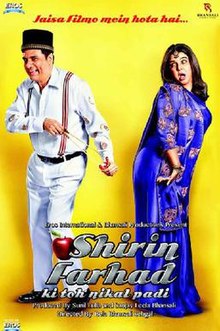
NEW: Shirin Farhad Ki Toh Nikal Padi has moments of brilliance in lots of mush


Synopsis: Farhad Pastakia (Boman Irani) is 45 years old, single and working as a bra and panty salesman. Everybody’s pestering him about getting married, and Farhad just wants to be left alone, to realize his dream of owning his own underwear store and to fall in love when he wants. Shirin Fuggawala (Farah Khan, in her acting debut) is much the same, middle-aged, pestered about her love life, and working for the Parsi Trust. And the two hit it off — Farhad’s head over heels before Shirin has much of a chance to say anything. You’d think everyone would be happy to see the middle-aged pair finding love, but it turns out Shirin and Farhad’s mom have been remotely battling for months over a water tank. And mummy’s not about to let her boy marry her dushman (“Yeh shaadi nahin ho sakti, nahin ho sakti, nahin ho sakti!" is her motto).
In a way, the premise of Shirin Farhad Ki Toh Nikal Padi (I had fun saying that to the white girl at the ticket counter, by the way) is great: “Love has no expiry date.” Bollywood could use something more than the 30- to 40-something man romancing an 18 to 20-something woman. (Although, why does Farhad have to be 45 instead of 52 — how old Boman Irani actually is? And why is an excuse provided for why Shirin hasn’t married yet, but one isn’t for Farhad other than “haven’t found the right girl”?)

And when it sticks to age jokes and quaint romancing, the movie is great. There’s a great song in which Shirin and Farhad parody Kuch Kuch Hota Hai, Hum Aapke Hain Koun…! and DDLJ, and all of the promo materials do the same. (Promo below has parts of the picturization.)


And then of course Boman Irani, genius actor that he is, is able to bring through Farhad’s  moments of struggle and frustration brilliantly. Not to mention being incredibly hilarious and endearing.

But otherwise, the film is a great big pile of mush.

Shirin Farhad Ki Toh Nikal Padi is mostly unable to escape Farah Khan’s poor acting. She’s just about every combination of bad acting you can imagine: cheesy, bland, slow, monotonous, overkill. The movie kind of jokingly tries to give her the typical glamor-diva scenes a Bollywood heroine gets, and she can’t even nail those — I’d have thought every woman knows how to work the glam seduction. (Also, I’d fall over dead if Farah Khan was actually a 36B like the movie claims. There’s no way.)

Terrible on the left, fabulous on the right.
And given how smooth and versatile Boman Irani is, Farah just looks that much worse.

I actually was really disappointed because I’ve always been a fan of Farah’s choreography and I even liked that supposed directing flop of hers, Tees Maar Khan. But really, she should stick to choreography and directing and producing.

Although on the subject of choreography, for a choreographer, Farah is also kind of an awful dancer. I would attribute it to middle age (ahem) were she not a choreographer. It’s really almost as painful as her acting at times.

And it’s not like she wasn’t given some decent acting material to work with — Shirin is a multifaceted character and wonderfully bossy. She just can’t work with it.

Ah, Farah. If only you could've done something with this sass.
Take lessons from the man who somehow makes this not creepy.
Overall though, the film doesn’t sustain its pockets of good material either. Like I said, aside from the age moments and quaint middle-age romancing, it’s all over the place. Fart jokes (a couple funny, a couple just dumb). Family craziness (and family crazies). Weddings. A couple of instances of Shirin and Farhad breaking and making up.

There’s also this kind of oddness about the film’s setting that bothered me. Everyone is quick to protect being Parsi, but everything about the movie screams Westernized, from the decorations of the family’s flat to the clothing (desi clothes come out pretty much at weddings and that’s all). The family is not so well off that Farhad doesn’t have to work, but folks wear designer glasses and carry fancy handbags. Shirin is obviously better off than Farhad (that in itself is something for any film), but this is somehow a film of designer glasses and lattes and so on all around.

Saturday, August 18, 2012

NEW: Ek Tha Tiger: Warring spies in love


It’s one we’ve all been waiting for… Ek Tha Tiger! Beware of spoilers below, though I tried to avoid the big ones!

Synopsis: Tiger (Salman Khan) is a ruthless RAW agent known for getting things done — and killing people (“Try not to kill anyone on this one,” his boss asks). Sent on a mission to observe an Indian scientist in Ireland, Tiger rediscovers his humanity as he falls in love with the scientist’s housekeeper, Zoya (Katrina Kaif). But as fate would have it, Zoya is actually an undercover Pakistani spy, the very last person Tiger should fall in love with.

So let’s just say I liked it despite my ongoing Sallu issues. I really enjoyed it, as a matter of fact, even though it wasn’t my favorite.

A few scattered thoughts:

Ek Tha Tiger is roughly comparable to Agent Vinod in several ways. It’s a spy flick based on a character who’s ostensibly RAW’s star agent, who then falls for a Pakistani woman. (Though there’s a key difference in this that I’ll discuss in a moment.) I tweeted after seeing the movie that in a way, Ek Tha Tiger feels like Salman’s response to the hailed-as-a-first-Bond-style-Bwood-spy-flick Agent Vinod: “Saif can be a desi spy? I can be a more badass desi James Bond!” (“Main James Bond hoon!” he actually yells in one scene.) I’ll skirt going into which one I liked more because there’s really a key difference in the two: Agent Vinod is a spy movie with a conspiracy-style plot and a Bollywood heart; Ek Tha Tiger is a Bollywood love story with a spy setting.

Another important (though less directional) difference is in each film’s treatment of Pakistan. Each film was banned in Pakistan, but after Sallu essentially campaigned for Ek Tha Tiger in Pakistan, the ban was lifted. But aside from that, it makes a lot of sense that of the two, Ek Tha Tiger was the one unbanned: Though it deals with the touchy subject of Indo-Pak relations, it’s really so evenhanded in its treatment that I have to wonder why it was banned at all. (Well, it’s because the Pakistani government is overly touchy; but that’s an argument for another day…) “I won’t betray my country,” Zoya says. “And I won’t betray mine,” Tiger responds. It’s an important difference because in Agent Vinod, Iram effectively betrays Pakistan, and Pakistan is behind nearly every nefarious dealing in the film. Ek Tha Tiger merely shows two countries senselessly at war, senselessly hating one another, neither more to blame than the other. “Our countries will keep fighting for who knows how long,” Zoya says. So she and Tiger agree not to play into their countries’ fighting — signaling romance winning over criticizing Pakistan.

Taking steps away from that, here are some comments more on the film itself:

The cinematography is really quite better than I actually anticipated. From excellent filter work to great moments that slow down action scenes to creative shots, the camera work was really quite top knotch.

And the action is, save its handful of groaningly exaggerated moments, actually quite good. From the standard chase-shooting scenes to a great across-the-rooftops segment in Cuba, they’re varied and well-done.

The one major exception? For a well-trained and supposedly valuable Pakistani spy, Zoya shows very little hand-to-hand prowess or even spy smarts until about ¾ of the way through the film. Instead, she’s usually prey to what I call film’s “helpless woman syndrome”...despite, yeah, HELLO, being a spy. It’s one of the things that makes me angriest about films. Why must a woman be helpless on screen when every bit of the film shows the man’s physical prowess?

Another random note about Zoya is that once she's made to look more "Pakistani," Katrina looks decidedly out of place in more traditional desi garb. Very awkward almost. And folks have come out of the woodwork to argue this with me, but I think Katrina also looks awkward and ridiculous in a scene where she carries bagpipes (which, by the way, are Scottish-style bagpipes and not Irish-style bagpipes). I say not even she can make bagpipes (not the outfit, but the bagpipes themselves) sexy, but evidently everyone disagrees.

So much sizzle it makes me wonder if they actually broke up.

Anyway, despite having definitely gone through a breakup, Salman and Katrina still have some definite chemistry on screen. An almost-kiss moment has your heart stopping for just a moment (in part because you actually think, “Wait, an onscreen kiss...between them?”), and then later, there’s a heavily romantic scene where she basically seduces him away from painting. And it’s great. (Totally irrelevant sidenote, but Katrina is definitely taller than Salman, but movie magic keeps trying to make him taller... Short Man Syndrome!)

The film has a fabulous international feel to it. From India to Dublin to Istanbul to Havana — with a certain small tribute to each locale along the way. And perhaps I’m biased because Dublin and Havana are high on my “wish I could travel there” lists, but I liked this far more than many globe-hopping films (and far more than Agent Vinod’s flavorless stream of locales).

Havana! (Sallu almost looks Latino!)
 

I particularly loved the stint in Havana, with its carefree feel, Spanish (me encanta!) and the classic cars (que bella!). I could rave forever about the cars, but I won’t.

I could also rave about how wonderful the tense moments, the cliffhangers that keep you guessing, are. But I’ll restrain myself because I really don’t want to spoil anything for anybody. (Feel free to discuss them in comments, though!) But especially the interval cliffhanger! Wow.

Bravo.

Saturday, August 11, 2012

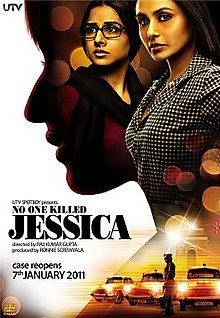
Why No One Killed Jessica is not a journalism movie


As I’ve mentioned in the past, I’m a journalist always looking for a good journalism movie. Films overwhelmingly have the tendency to portray journalists either crusaders or scumbags; neither is often very accurate. When I mentioned my quest for a solid Bollywood journalism movie, several people recommended No One Killed Jessica to me.

I put it off and put it off, but recently I finally did sit down and watch the film.

The facts are this: It’s a good film. It’s not a good journalism film.

In case you don’t know, No One Killed Jessica is based on the real-life murder of Jessica Lall: A minister’s fatally son shoots Jessica in a club because she won’t give him a drink. But when the police investigate, the minister’s goons buy off and intimidate everyone away from testifying. Jessica’s sister, Sabrina (Vidya Balan), leads the uphill fight for justice. The court eventually finds the man not guilty and lets him free. But journalist Meera Gaity (Rani Mukherjee), a former war correspondent, refuses to let it go and publicizes the story, eventually helping to work up outrage that reopens the case and results in a guilty verdict.

Why is this a good film? Because it’s a moving story of the tragedy of the murder, a sister’s refusal to give up seeking justice, the painful reality of corrupt Indian politics and legal system, a nation’s outcry over the injustice of it all. And of course there are great performances from Rani and Vidya.

Why is it not a good journalism film? There’s little or — dare I say — no actual journalism in the film about the murders.

No one journalist investigates the murders. All of the damning evidence that later stirs up public fury is effectively dropped in Meera’s lap. She merely goes on television to present it — that’s not journalism. The most any of the other journalists do is insist — and fail in their insistence — that this is a story. Yes, that’s a part of journalism. But to think that journalism ends there — in deciding what is a worthwhile story — is a great, great failure.

Having the guts to talk about a story is important.
But looking pretty for a camera to present evidence
you didn't work for isn't journalism.

Another great problem in treating this film as a picture of journalism comes in the fact that this film definitely steps outside what we consider journalism’s role and bounds. In the United States, potential jurors are screened for their knowledge of a case based on media coverage and then later ordered to avoid media coverage of the case, lest they be influenced or biased by the media’s coverage or encounter evidence that isn’t presented in trial.

The reason? There is a significant danger in conducting trials in the court of public opinion rather than a court of law. Certainly with a corrupt law enforcement system, it’s tempting, but it’s also dangerous. Ask anyone who has been wrongfully accused or, worse, convicted due to media coverage.

And the film entirely ignores this problem. The murderer is tried and convicted in the mind of Meera — and then the minds of the people who watch her news shows — before the evidence truly comes out. That is not justice.

In the film, this, despite being highly problematic, is allowed to work because the man is guilty. It works because we know from the case in real life that the man was guilty.

But in pure journalism terms, I have a significant problem with it.

It is not a journalist’s job to put a man on trial, to prove that he is guilty or innocent. It is a journalist’s job to present the public with the unvarnished facts.

Yes, outrage often spawns reform. But it isn’t a journalist’s job to spawn outrage, either. It’s a person’s right, the public’s right, to decide whether something is outrage-worthy. Using the media to start things like that is a very slippery slope.